
Overview
Your domain-specific model achieves 85.3% accuracy, but production requires 95%+. What do you do? This talk explores how ensemble models and multi-source data synthesis can bridge the gap when single GenAI models fall short.
Through a real-world case study of classifying customer support tickets for a building products company, discover how the "judge pattern" achieved 100% accuracy while maintaining explainability and cost-effectiveness. Learn when to use ensemble approaches, how to synthesize multiple data sources for greater value, and practical deployment strategies including shadow mode validation.
Key Takeaways:
- When your domain-specific model hits 85% accuracy but production demands 95%+, ensemble models can bridge that critical gap
- The "judge pattern" emerged as the winner by combining a fast NLP pipeline with an LLM judge that only reviews uncertain cases, achieving 100% accuracy while staying cost-effective
- The real breakthrough wasn't just ensembling models—it was ensembling data sources across manufacturing silos (BOMs, spec sheets, work instructions) to create richer context
- Real-world impact: 2x improvement in customer satisfaction and 1,400% ROI, proving that thoughtful ensemble design scales in production
- Start simple with shadow mode deployment, monitor everything obsessively, and remember that your domain expertise is what makes these systems work
Preview Video
Watch the preview of this talk:
Presentation Slides
Download the complete slide deck from this presentation to dive deeper into the technical details, case studies, and implementation strategies.
Download Slides (PDF)Talk Highlights
The Challenge
Client: A building products company
Problem: Classify customer support tickets into categories
- Warranty
- Technical Support
- Order Status
- Installation
- Product Information
- Troubleshooting
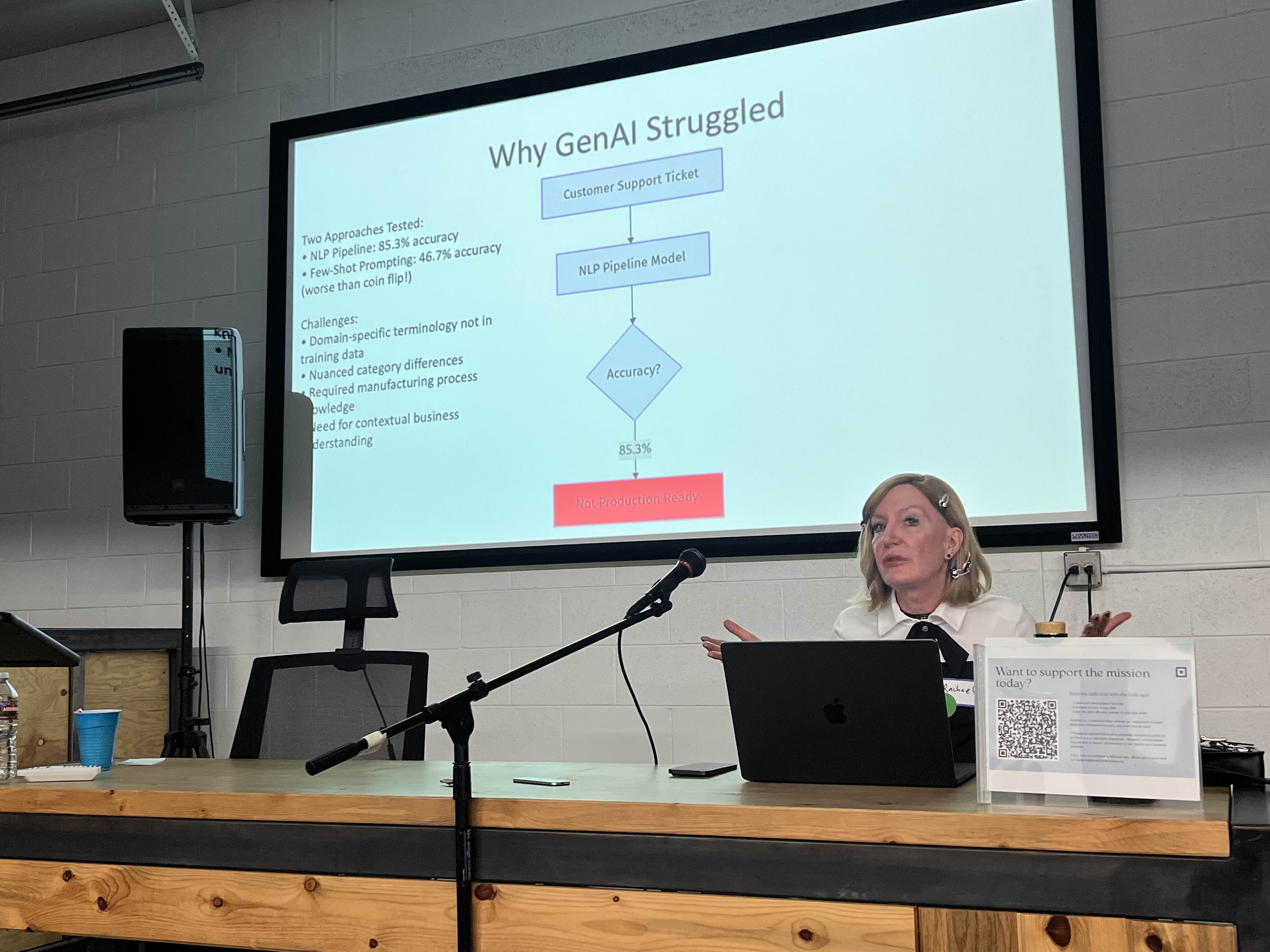
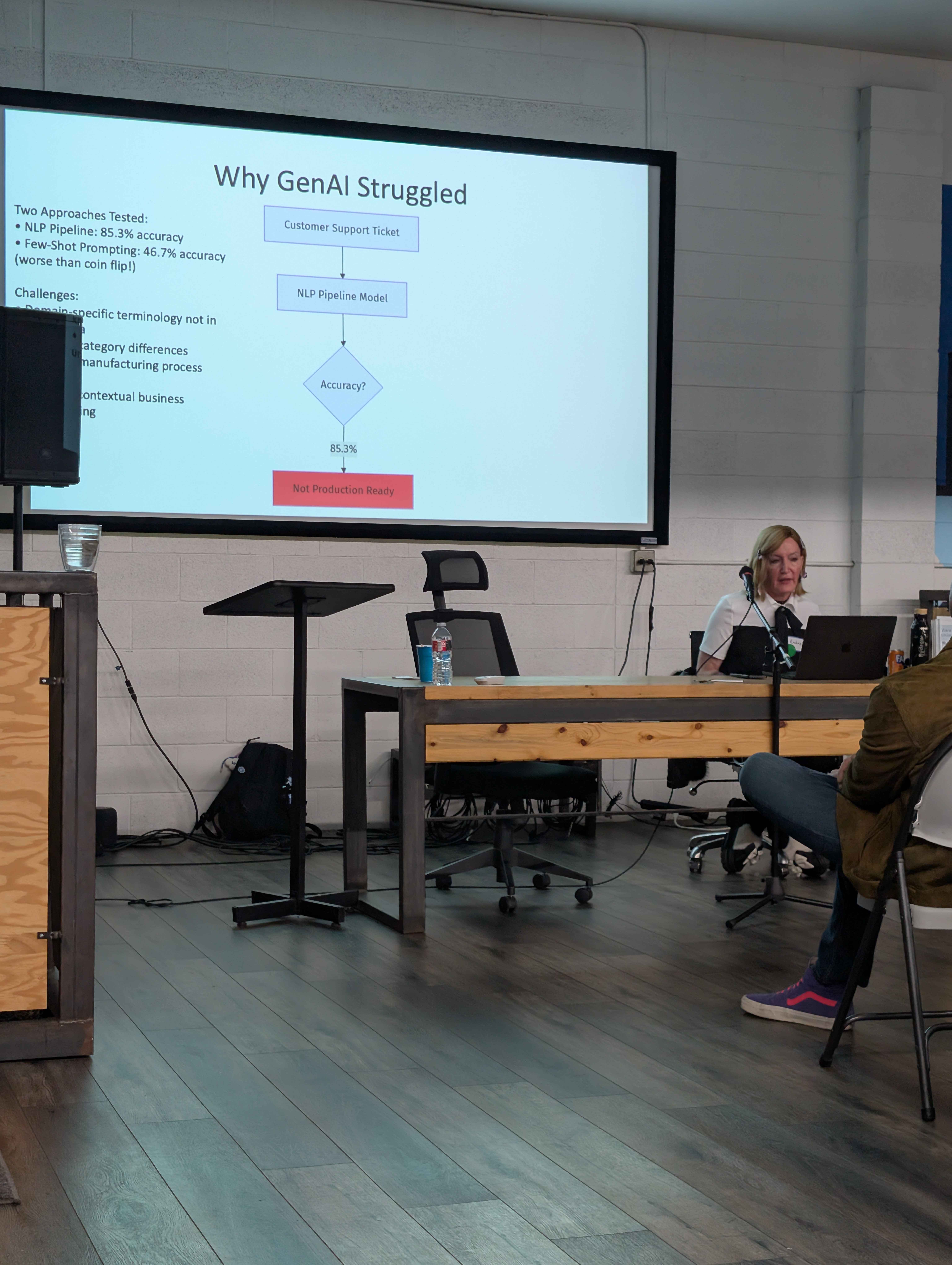
Why GenAI Struggled
Two Approaches Tested:
- NLP Pipeline: 85.3% accuracy
- Few-Shot Prompting: 46.7% accuracy (worse than coin flip!)
Challenges:
- Domain-specific terminology not in training data
- Nuanced category differences
- Required manufacturing process knowledge
- Need for contextual business understanding
The Ensemble Solution
"When one model isn't enough, use multiple models working together"
Three Strategies Tested:
- Voting Ensemble - Multiple models vote, majority wins
- Judge Pattern - Pipeline + LLM judge reviews
- Hybrid - Voting + judge arbitration
Result: All three achieved 100% accuracy! Judge pattern provides explainability + accuracy.
Why Judge Pattern Won
Advantages:
- Explainable (judge provides reasoning)
- Cost-effective (only invokes when needed)
- Easy to improve (add few-shot examples)
- Higher accuracy than voting
When Judge Runs:
- Pipeline confidence < 90%
- ~30% of tickets need judge review
- Cost: $0.005 (pipeline) + $0.03 (judge when needed)
The Power of Synthesis
"Don't just ensemble models. Ensemble data sources."
Manufacturing companies have data silos:
- BOMs (Bill of Materials) - Component relationships
- Spec Sheets - Technical specifications
- Work Instructions - Assembly procedures
- Support Tickets - Historical issues
Key Insight: Synthesized answers provide specific recommendations, technical justification, part compatibility, installation guidance, risk mitigation, and source citations. Value > Sum of Parts.
When to Use Ensembles
Use Ensembles When:
- Single model accuracy is 85-90% (good but not great)
- Domain is highly specialized
- Errors have meaningful business cost
- You have budget for multi-model inference
- You need explainability
Don't Use Ensembles When:
- Single model already achieves 95%+
- Domain is well-covered by training data
- Errors are low-cost
- Latency/cost is critical
- Simple rules work well
Event Photos


About the Speaker
Rachael Roland (she/her)
Founder, Applied Industrials
Building AI systems for industrial companies with a focus on domain-specific NLP challenges. Rachael specializes in solving the hard problems that arise when off-the-shelf AI models aren't enough for specialized industrial applications.
Connect with Rachael on LinkedIn